Pre-European Māori History
One of the earliest groups of indigenous inhabitants of the Lyttelton Harbour area were the Waitaha people, descendants of the renowned Captain of the Tākitimu canoe Tamatea-Pokai-Whenua who arrived in the area from Poverty Bay in the North Island during the mid fourteenth century and named it Whangaraupō or Whakaraupō (‘harbour of raupō’).
Waitaha were succeeded by Ngāti Māmoe who named the area now known as Lyttelton Ōhinehou. Ōhinehou was the name of a Ngāti Māmoe pā or village which was probably situated on the western side of Lyttelton situated near to the present day rail tunnel mouth.
Ngāi Tahu in turn succeeded Ngāti Māmoe in the eighteenth century and settled at nearby Rāpaki, erecting a pā at Ōhinetahi (Governor’s Bay). The area suffered heavily from Te Rauparaha’s raids in the 1830s and the effect was devastating for most of the local Māori population. By the time early European settlers explored the area that was to become Lyttelton, it appears there was no longer a village or pā at Ōhinehou.
Lyttelton: a planned Church of England (Anglican) settlement
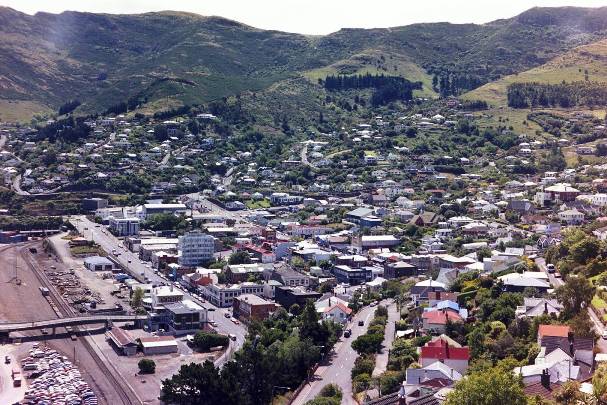
Lyttelton was a planned colonial settlement dating from 1849. The idea of Lyttelton port and township was conceived by Edward Gibbon Wakefield and John Robert Godley, who formed the Canterbury Association as part of their planned programme of systematic colonisation. Backed by influential English peers, members of the British Parliament and clergy, the Canterbury Association had the ambitious aim of gaining high land sale prices in order to attract a high class of settlers and fund the foundations of a specifically Church of England settlement. The Canterbury Association Chairman was George William Lyttelton, the fourth Baron Lyttelton, after whom the Lyttelton township and port is named.
With separate port town (Lyttelton), capital town (Christchurch), and outlying market towns, the Association aimed for a relatively decentralised village society. The settlement reflects both mid nineteenth century colonial planning models and the realities of the requirements of building and settling in the dramatic volcanic landscape with its steep topography. Despite the Canterbury Association’s plans that it would be a Church of England Settlement, people of many denominations had inhabited Lyttelton from the outset. It was some time before any recognisable ecclesiastical buildings were constructed in Lyttelton and religious services were initially held in the Immigration Barracks.
Holy Trinity Church
Canterbury Association settlers built the first permanent Anglican church in Lyttelton in 1852, only two years after the arrival of the first Canterbury Association settlers. Designed by colonial architect, Benjamin Woolfield Mountfort, the first Church of the Holy Trinity at 17 Winchester Street in Lyttelton was an ambitious timber building that soon proved to be unsound in high winds. The parish eventually decided that it was not worth repairing the timber church and it was replaced by a second church, to a design by architect George Mallinson. This second Holy Trinity Church, built in 1859-60 on the same site as the first, was constructed of red porphyry volcanic stone, but reused ‘a great portion’ of the timber from the first church in its interior. Early English Gothic in style, the church contained notable features such as some of the earliest stained glass windows to be imported into the Christchurch diocese. At its consecration, led by the first Bishop of Christchurch, Henry John Chitty Harper, the church was recognised as being the first stone church in the diocese.
Church of St Saviour
Bishop Harper was interested in the pastoral care of the numerous seamen who called into the Port of Lyttelton. In 1879 the Reverend Arthur Davidson was appointed chaplain to various public institutions, including the seamen of Lyttelton. Bishop Harper took this a step further by utilising an endowment made by former Holy Trinity Church vicar (1851-9), Benjamin Woolley Dudley, for a church on sections in land parcel RS 40, at Dampier’s Bay (as West Lyttelton was then known). Harper combined Dudley’s endowment, a guarantee from Church Property Trustees and private subscriptions to enable an additional Anglican church at Lyttelton – the Church of St Saviour – to be built at West Lyttelton. The Holy Trinity vestry were persuaded to agree to a division, the deciding factor being that the Reverend Dudley’s endowment could only be obtained if a second church was built.
At the request of Bishop Harper, in early January 1884, Christchurch architect Cyril Julian Mountfort prepared plans for a timber church at West Lyttelton to accommodate up to 200 worshippers, but capable of being extended. In May 1884 a fundraising committee was established and tenders were called for the church in both wood and brick. Subscriptions were sought and obtained from both the people of Lyttelton and the wider Anglican diocese. At the same time, Bishop Harper wrote to the Missions to Seamen in London requesting books suitable to distribute to the seamen of the Port.
In April 1885, the Reverend Edward Eliot Chambers, a former lieutenant in the Royal Navy was appointed Curate of Dampier's Bay (West Lyttelton). In August 1885 a tender for £673.13.0 was let to local builders and undertakers, Messrs Sutton and Weastall, to construct the church in timber at the corner of Brittan Terrace and Simeon Quay in West Lyttelton.
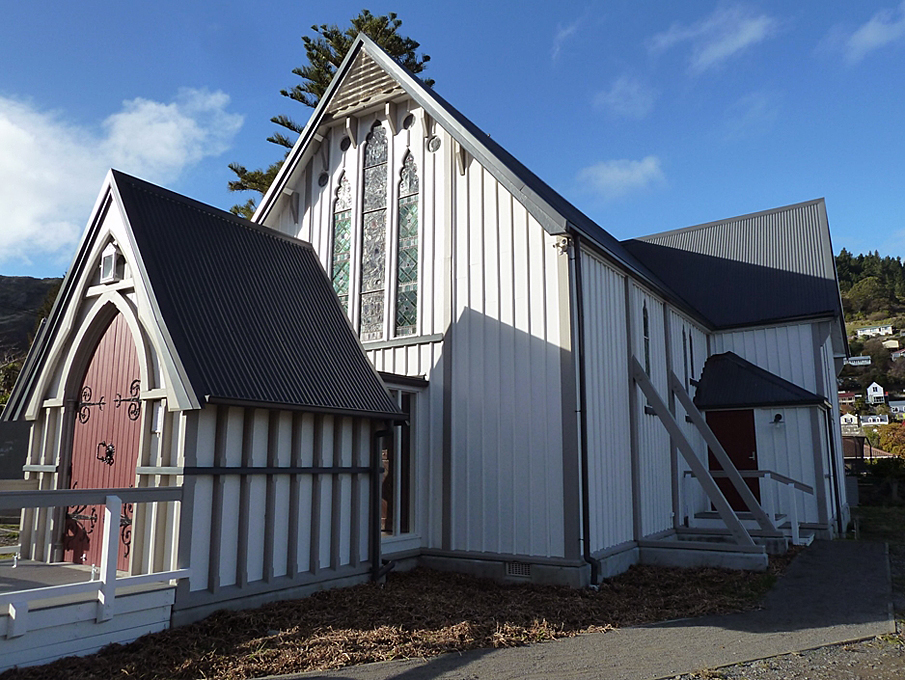
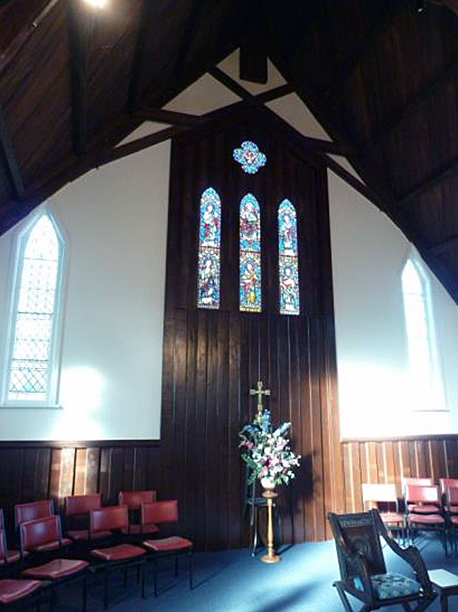
West Lyttelton was constituted a Parochial District on 22 October 1885, and seven days later the new church was consecrated as the Church of St Saviour. On the day of consecration, the church was considered only partly complete: the transepts and chancel were built, but Mountfort’s original plan had included a 30 foot extension to the nave. Nevertheless, the church was considered a lofty building for its size, well ventilated, with good acoustics and excellently lit by the lance-shaped windows filled by stained glass.
Inducted as first vicar, the Reverend E Eliot Chambers was to minister to seamen and parishioners for thirty-six years. He encouraged church parades, and a range of training groups with military associations attended services at the Church of St Saviour. While it is often said that the Antarctic explorers, including Captain Robert Falcon Scott and the crews of the Discovery and Terra Nova were closely associated with the Church of St Saviour, it is not clear if they actually worshipped there. However, farewell services involving the Reverend Chambers were conducted on board ship in 1901 before Robert Falcon Scott’s Discovery sailed, in 1908 before Nimrod sailed with Ernest Shackleton and again in 1910 before Scott’s fateful trip in Terra Nova.
The growth predicted for the St Saviour’s congregation did not eventuate, and three bays of the nave and a steeple that featured in the original plans were never built. Minor alterations and additions were made to the church though. In 1901 the building was repaired and re-roofed by builders Hollis and Brown and in 1906 the same firm extended the vestry. During 1916, a new buttress was installed by Messrs Fletcher and Walsh. After Chambers’ death in 1921, parishioners subscribed to the cost of a large stained glass window dedicated to his memory. This window, ‘Christ Calming the Waters’, was produced by Smith and Smith Ltd of Christchurch, and installed in 1922.
Following Chambers’ death, the Rev T M Curnow was appointed vicar in September 1921. Around this time there was a proposal from the Parish of Lyttelton for a reunification of the two parishes, but this was firmly rejected by West Lyttelton. In 1930 the West Lyttelton parish was extended to include Governors Bay and Teddington. Despite this, church attendances at both Lyttelton parishes were in decline through the 1930s, and eventually the West Lyttelton parishioners themselves requested that the two parishes be reunified. This took place on a trial basis in 1938. In 1946 it was realised that one man could not effectively minister to such a large area, and the two parishes were again split. St Saviour’s became part of a new Lyttelton West parish that included Teddington, Governors Bay and Diamond Harbour. This arrangement remained until 1964, when the urban area of Lyttelton was reunited as a single entity. It is thought that the Church of St Saviour thereafter became increasingly peripheral to the activities of the new parish, particularly so following a renovation of Holy Trinity Church in the early 1970s. As a consequence, parishioners gave the church to the Christchurch Diocese in 1975, with instructions that a new home be found for it. Requests for the building were received from the Parklands parish and Cathedral Grammar School, the latter being the successful applicant.
St Saviour’s Chapel at Cathedral Grammar School
The Cathedral Grammar School, located opposite Hagley Park in central Christchurch, had utilised various buildings on its site for worship since its foundation in 1881. The first chapel was a classroom converted in 1930, and replaced with another, first floor space in 1936. Due to increasing numbers of pupils in the late 1940s, the former gymnasium was adapted in 1951-2 to serve jointly as a war memorial hall and chapel. It was not until the acquisition of the Church of St Saviour in July 1975, however, that the school acquired its first 'purpose-built' chapel. The West Lyttelton church was dismantled and moved in sections over Evans Pass to be assembled (and reoriented with the altar to the west) on a new site on the corner of Park Terrace and Chester Street, Christchurch, in early 1976. The old site in West Lyttelton was subsequently redeveloped by the parish for social housing. Renamed St Saviour’s Chapel, the relocated and renovated building was officially reopened on 26 June 1976 by the Bishop of Christchurch, the Right Rev W A Pyatt. The furniture from the original church was transported onto the new site, with the exception of the altar. This was gifted to the Chapel of the Snows at McMurdo Station in Antarctica.
Repairs and refurbishment took place in the late 1980s and in 1999 the roof was replaced.
Canterbury Earthquakes
From 4 September 2010 and the years following Canterbury suffered a series of major earthquakes. They caused considerable destruction and many historic buildings have been lost as a result. Lyttelton’s Winchester Street – previously referred to as the ‘street of churches’ – lost its three historic churches, including Holy Trinity Church at 17 Winchester Street. Holy Trinity Church was badly damaged in the 4 September 2010 earthquake, and some walls partially collapsed during the 22 February 2011 earthquake. It completely collapsed in an earthquake on 13 June 2011, and its remains were removed later that year. Although St Saviour’s Chapel in its relocated spot in Christchurch suffered only minor damage in the Canterbury earthquakes, in 2012 the Cathedral Grammar School advised that St Saviour’s Chapel was no longer large enough for their school, and that remediation of the land meant that it had to be moved. It was given back to Church Property Trustees.
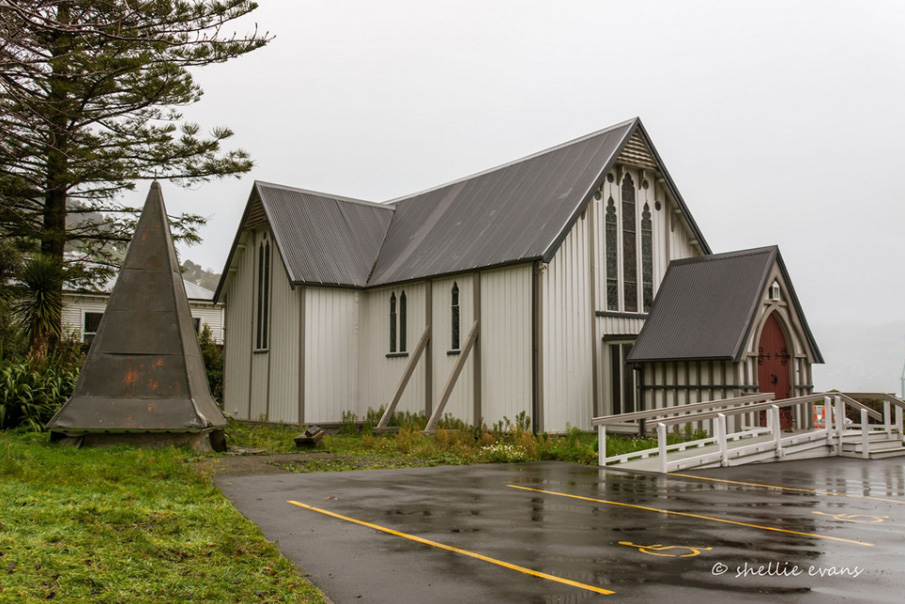
Church Property Trustees decided that St Saviour’s should be returned to Lyttelton and it was deconsecrated on 30 July 2012. The choice of relocating the church to Lyttelton was considered appropriate. Its original location in West Lyttelton remains occupied by the social housing complex built after it was first shifted in the 1970s, but the vacant site left by the demolition of Holy Trinity Church in Winchester Street was suitable for the relocation of St Saviour’s. In 2013 the timber St Saviour’s Chapel was cut into ten pieces and in September of that year it was moved, through Gebbies Pass, to the Winchester Street site previously occupied by Holy Trinity Church. On this new site, it was reassembled but with some changes: it was turned around on its original east-west axis to make better use of the space, some features were shifted and some items salvaged from Holy Trinity Church have been incorporated in its refurbishment. In this way, elements of the two churches have been combined. Church Property Trustees staff worked with a consultant team, including engineers Holmes Consulting Group, Powell Fenwick, Dave Pearson Architects and Warren and Mahoney Architects to achieve the outcome. Repair and restoration of stained glass windows was carried out by Stewart Stained Glass. The church was consecrated by Bishop Victoria Matthews on 7 June 2015. The re-siting of St Saviour’s at the site formerly occupied by Holy Trinity once again provides a place of worship in Lyttelton. The efforts to retain the heritage values through the relocation of St Saviour’s to the Holy Trinity site were recognised in the 2015 Christchurch Civic Trust Awards.